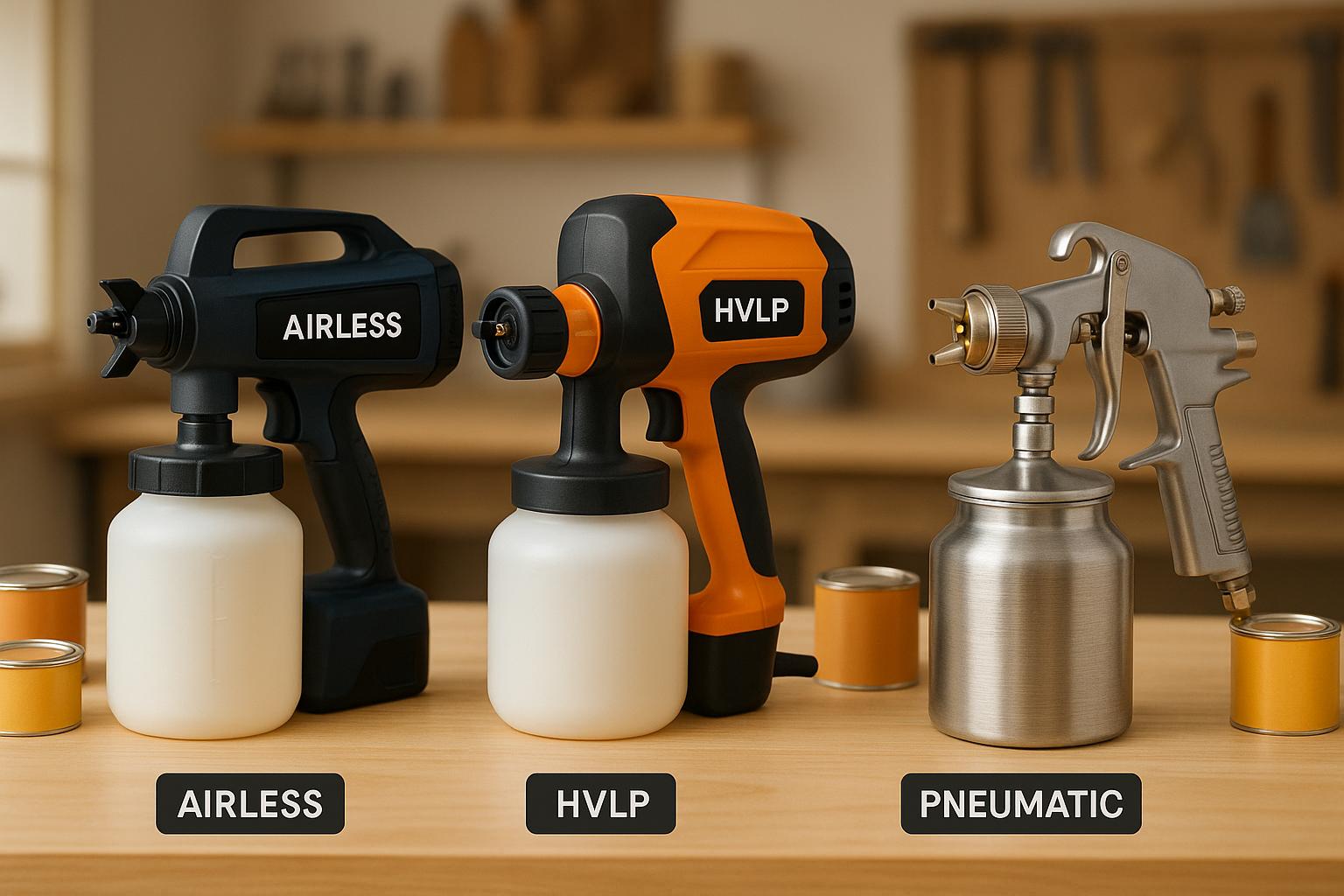
Paint sprayers make painting faster and smoother compared to brushes and rollers. Whether you're working on furniture, walls, or your home's exterior, choosing the right sprayer is key. Here's a quick breakdown:
- Airless Sprayers: Great for large projects like fences or exteriors. They handle thick paints but require careful handling due to high pressure.
- HVLP Sprayers: Ideal for precision work like cabinets or furniture. They use low pressure, reducing overspray but are slower for big jobs.
- Pneumatic Sprayers: Budget-friendly for small tasks if you already own an air compressor. They may waste more paint due to overspray.
Each type has its strengths depending on project size, paint type, and your experience. Always consider ease of use, maintenance, and cost when selecting a sprayer.
How to Select the Best Paint Sprayer for Your Project
Main Types of Paint Sprayers
Choosing the right paint sprayer can make a big difference in how efficiently and effectively you complete your project. Each type of sprayer uses a unique method to atomize paint, and understanding these differences helps you pick the right tool for the job.
Airless Paint Sprayers
Airless paint sprayers are a go-to choice for both professionals and DIY enthusiasts tackling home improvement projects. They work by pushing paint through a pressurized hose at extremely high pressure, breaking the paint into fine droplets for a smooth, even finish. Unlike other sprayers, airless models don’t mix air with the paint - they rely entirely on pressure.
One of their standout features is their ability to handle thick paints and coatings, like latex, oil-based paints, stains, varnishes, and lacquers. For especially dense materials such as elastomeric coatings or blockfillers, contractor-grade airless sprayers are powerful enough to get the job done.
These sprayers shine on large surfaces where speed is key, such as home exteriors, fences, decks, barns, or even unfinished interior walls. Thanks to their high flow rates (measured in gallons per minute), they can drastically cut down the time it takes to complete big projects.
Tip sizes play a crucial role in performance. For example:
- Lacquers and stains: 0.009–0.013 inches
- Oil-based paints: 0.013–0.015 inches
- Latex: 0.015–0.019 inches
- Heavy latex: 0.021–0.025 inches
- Thick coatings (elastomeric or blockfillers): 0.025–0.035+ inches
Many airless sprayers come with reversible tips, allowing you to clear clogs mid-project without much hassle. However, working with such high pressure requires strict safety measures. Thicker paints like latex may need thinning to prevent clogging, while thinner materials like varnishes usually don’t require any adjustments. Regular cleaning of the tips is essential to maintain performance.
If precision is more important than speed, HVLP sprayers are worth considering.
HVLP Paint Sprayers
HVLP (High Volume Low Pressure) sprayers take a different approach, using a steady flow of low-pressure air to atomize paint. This creates smaller, slower-moving particles that stick to the surface more effectively, reducing overspray and delivering an even, professional-quality finish.
These sprayers are perfect for detailed projects where control and precision are key, such as painting cabinets, trim, furniture, or décor. They’re also excellent for intricate tasks like ceilings and decks. Their low-pressure design makes them ideal for delicate applications.
HVLP sprayers work well with water-based and oil-based paints and stains, but they may struggle with thicker materials like lacquers and varnishes unless you’re using a specialized commercial-grade model. The low-pressure system also means you’ll need to refill the paint reservoir more often, which can slow down larger projects. While these sprayers typically cost more upfront than pneumatic models, their efficiency and superior finish often justify the expense. Keep in mind, HVLP systems require an air compressor to operate.
If affordability is your main concern, pneumatic sprayers offer a budget-friendly alternative.
Pneumatic Air Sprayers
Pneumatic sprayers, or compressed air sprayers, rely on compressed air to atomize and apply paint. They’ve been around for years and are widely used in commercial and industrial settings for tasks like painting furniture, cabinets, molding, doors, and even automotive parts.
Their main advantage is cost - the spray guns are generally less expensive than those used in airless or HVLP systems. However, pneumatic sprayers tend to produce more overspray, which means more time spent masking and cleaning up, as well as higher paint waste. They can handle lacquers effectively if the paint is properly thinned. Safe operation requires careful attention to hose connections and pressure settings.
For smaller projects or budget-conscious users who already own an air compressor, pneumatic sprayers can be a practical choice. That said, for interior jobs where overspray could cause damage or when paint efficiency is a priority, an HVLP sprayer might be a better long-term investment.
| Feature | Airless Sprayers | HVLP Sprayers | Pneumatic Air Sprayers |
|---|---|---|---|
| Atomization Method | High pressure, no air | High volume, low pressure air | Compressed air |
| Best Applications | Large exteriors, fences | Cabinets, trim, detailed work | Small commercial projects |
| Paint Compatibility | Thick paints, latex | Water/oil-based paints, stains | Water/oil-based paints |
| Overspray Level | Moderate | Low | High |
| Speed | Fast coverage | Slower due to refills | Moderate |
| Compressor Required | No | Yes | Yes |
| Typical Cost | Higher upfront | Moderate | Lower (gun only) |
| Pressure Level | Very high | Low | Varies |
Each sprayer type has its strengths. Airless sprayers are perfect for large-scale projects and thicker materials, HVLP sprayers excel at detailed work, and pneumatic sprayers offer a cost-effective option for smaller tasks.
Choosing the Right Paint Sprayer for Your Project
Selecting the right paint sprayer can make or break your project. A poorly matched sprayer can lead to wasted paint, uneven finishes, and unnecessary headaches. On the other hand, the right choice can save time, reduce effort, and deliver professional-quality results.
Project Types and Scales
The size and type of your project should guide your decision. Different sprayers are designed for specific scales of work, and using the wrong one can slow you down or compromise your results.
Small-Scale Projects: For tasks like refinishing furniture, painting decorative items, or working on trim, precision is key. HVLP sprayers are a great fit here, offering fine, controlled finishes. Pneumatic sprayers are another option, especially if you already own an air compressor.
Medium-Scale Projects: Jobs such as painting a single room, multiple pieces of furniture, or a small deck require a balance of speed and detail. HVLP and pneumatic sprayers both work well for these kinds of tasks. For interior work like painting cabinets, ceilings, or trim, HVLP sprayers are particularly effective.
Large-Scale Projects: For big jobs like painting home exteriors, fences, barns, or large interior walls, speed and coverage are crucial. Airless sprayers are the go-to option here, especially for projects requiring three or more gallons of paint. Models like the Graco Magnum X7 provide fast, even coverage[3]. If you’re working outdoors without access to electricity, gas-powered airless sprayers offer portability, while electric models are ideal when outlets are nearby.
Feeding systems also play a role. Direct feed sprayers, which draw paint directly from 1- or 5-gallon containers, are perfect for large jobs that need a continuous paint supply. For smaller, detailed work, pressure-fed cup sprayers are a better match. Hopper-style sprayers offer versatility for projects that mix different types of tasks.
Once you’ve matched the sprayer type to your project size, it’s essential to ensure compatibility with the materials you’ll be using.
Material and Paint Compatibility
Not all sprayers handle every type of paint or coating equally. Knowing which sprayer works best with your chosen materials is vital for achieving a smooth, professional finish.
Water-Based, Oil-Based, and Thick Paints: While most sprayers can handle water- and oil-based paints, airless models are better suited for thicker formulations. HVLP sprayers, on the other hand, are ideal for standard paints that require precision. For extremely thick coatings, contractor-grade airless sprayers are a must.
Lacquers and Varnishes: Airless sprayers are versatile enough to handle varnishes and lacquers, making them a solid choice for finishing work. Pneumatic sprayers also perform well with these materials. However, HVLP sprayers should only be used for lacquers if they are designed for commercial-grade applications.
Stains: Stains are compatible with all sprayer types. Airless sprayers can quickly cover large areas like decks and fences, while HVLP sprayers allow for detailed applications on furniture and small woodwork. Pneumatic sprayers strike a balance, making them suitable for medium-sized staining projects.
Efficiency is another factor to consider. HVLP sprayers have a higher transfer rate than conventional air spray guns, which means less paint waste and a more environmentally friendly approach. LVLP (Low Volume Low Pressure) guns take this efficiency even further, while air-assisted airless sprayers combine high transfer rates with fast application speeds.
For indoor projects, minimizing overspray is often a priority. HEA (High Efficiency Airless) technology in some airless sprayers can reduce overspray by up to 55%[3], cutting down on paint waste and making cleanup easier.
Power levels also influence material compatibility. High-powered sprayers can handle denser materials, while lower-powered models are better suited for thinner coatings. Features like adjustable flow control let you manage how much paint is released, and pattern control options - such as vertical, horizontal, or circular - help you achieve the exact finish you want. For instance, the Graco Truecoat 360, with its 10-speed settings, provides excellent control for a variety of applications[4].
When deciding on a paint sprayer, think about the materials you’ll use most often. If your projects involve standard latex paints on large surfaces, an airless sprayer is a reliable choice. For smaller projects like refinishing furniture with stains or clear coats, an HVLP sprayer is a better fit. And if you frequently switch between different materials and project types, a pneumatic sprayer paired with a quality air compressor offers the flexibility you need.
Key Factors to Consider When Selecting a Paint Sprayer
Once you've chosen the right type of sprayer for your project, it's time to dive into the practical details. Beyond matching a sprayer to your project and materials, there are several factors that can make or break your satisfaction with the purchase. These considerations ensure your sprayer not only performs well now but also remains reliable over time.
Budget and Cost Considerations
Paint sprayer prices vary widely, so knowing your budget upfront can help narrow your options. If you're a DIYer tackling occasional projects, entry-level models like the Graco TrueCoat 360DS or Wagner FLEXiO 590 (priced around $145–$182) are worth considering. These are great for sporadic use and small-scale tasks[3].
For homeowners with frequent projects, mid-range sprayers priced between $199–$250 - such as the MaXpayer M1, NEU MASTER 3000 PSI, VEVOR 750W, and Dotool 3300 PSI - offer better durability and more adjustable features[3]. If you need something for professional-grade work, expect to spend $330–$390 on models like the Graco Magnum X5 or Titan ControlMax 1900 Pro. While the initial cost is higher, these sprayers are built for heavy, repeated use and can last for years with proper care.
Power sources also play a role in cost. Electric sprayers are budget-friendly to operate, while cordless models offer flexibility but may require additional batteries for longer jobs. Gas-powered sprayers, while powerful, come with higher fuel and maintenance expenses[2].
Don't overlook hidden costs, especially with pneumatic sprayers. While the spray gun itself might seem affordable, you'll need an air compressor, which can add $100–$500 depending on its capacity[2]. Material waste is another factor to consider. Conventional air spray guns can waste 40–50% of paint through overspray, while HVLP sprayers achieve 50–60% transfer efficiency. LVLP sprayers are even more efficient, with 70–95% transfer efficiency[5]. On a 2,000-square-foot exterior project, this difference could save you 5–10 gallons of paint, or $50–$150 in material costs.
Lastly, think about long-term expenses like replacement parts and warranty coverage. Professional models often come with warranties lasting 3–5 years, providing added peace of mind.
Ease of Use and Maintenance
The ease of operating a paint sprayer can vary significantly depending on the type. HVLP sprayers are the most user-friendly, thanks to their lower pressure and straightforward controls[1]. On the other hand, pneumatic sprayers require familiarity with air compressors, including managing air pressure, cleaning filters, and draining moisture, which can be intimidating for beginners[2].
Airless sprayers, operating at pressures as high as 3,000–3,300 PSI, have a steeper learning curve. Achieving an even finish without excessive overspray takes practice, though some models include adjustable controls to help users ease into the process[1][3]. For example, the Graco TrueCoat 360 Variable Speed Paint Sprayer offers 10 speed settings, allowing beginners to start slow and build confidence[4].
For thinner paints, LVLP sprayers are a great option. They work with smaller air compressors and are generally more affordable, but they're limited to low-viscosity materials[5].
How the paint is fed into the sprayer also impacts usability. Direct feed systems, which draw paint straight from the container, are simple to set up. In contrast, pressure-fed cup systems and hopper systems require a few more steps[2]. Overall, HVLP sprayers are easier to assemble compared to airless models, which may need priming and pressure adjustments.
Maintenance is another key consideration. HVLP sprayers require regular cleaning of the cup and spray tip, along with occasional turbine system maintenance[2]. Airless sprayers demand more upkeep, such as frequent pump flushing and spray tip replacements, to prevent clogs and wear[1][2]. Pneumatic sprayers also need consistent compressor maintenance. Set aside 15–30 minutes for cleaning after each use to keep your sprayer in top condition.
Performance and Durability
Performance features like pressure levels and flow rates are critical for both efficiency and finish quality. Airless sprayers, with pressures of 3,000–3,300 PSI, can handle thicker materials and cover large areas quickly[2][3]. However, their high pressure requires more skill to control.
HVLP sprayers, which use high air volume at low pressure, produce finer spray patterns ideal for detailed work and smooth finishes[1][2]. Pneumatic sprayers rely on the air compressor's capacity to achieve the desired pressure and finish[2].
Flow rate matters too. For instance, the Graco Magnum X7 delivers a flow rate of 0.31 gallons per minute, making it efficient for large surfaces[3]. Features like adjustable flow control, pattern selection, and speed settings add versatility, allowing you to tailor the sprayer to different tasks.
For extended projects, lightweight sprayers (under 20 pounds) are easier to handle, especially when working overhead or on ladders[3].
Durability depends on the sprayer type and build quality. Professional-grade airless sprayers are designed to withstand frequent, high-pressure use[1][2]. While HVLP sprayers aimed at DIY users may not be as heavy-duty, they can still last for years with proper care[2]. For pneumatic sprayers, the compressor's quality and maintenance play a big role in overall durability[2].
Conclusion
Choosing the right sprayer for your project boils down to matching its features with your specific needs. Each type of sprayer has its strengths, depending on the scale of the job and the materials you're working with. For instance, airless sprayers are perfect for tackling larger tasks - like painting house exteriors, fences, or decks - thanks to their speed and power, which make covering large areas a breeze. On the other hand, HVLP sprayers shine when precision and a smooth finish are priorities, making them ideal for furniture, cabinets, and trim. If you're working on smaller, detail-oriented projects, pneumatic sprayers provide excellent control.
When deciding, consider a few key factors: the size of your project, the type of material you'll be using, and your level of experience. Thicker materials such as latex paints and primers typically work best with airless sprayers, while finishes like varnishes and lacquers are better suited for HVLP systems.
Budget is another important factor. Sprayer costs can range from affordable options for occasional DIY use to professional-grade models that come with higher upfront and maintenance expenses. Over time, efficient sprayers can help cut down on material waste, saving you money. Lastly, think about ease of use. HVLP sprayers are often more beginner-friendly, while airless sprayers - operating at pressures of 3,000–3,300 PSI - might take some practice to handle confidently[3].
FAQs
What safety measures should I follow when using a high-pressure airless paint sprayer?
When working with an airless paint sprayer, safety should always come first due to the high-pressure system it uses. Make sure to wear the right protective gear, including safety goggles, gloves, and a respirator mask. This will help protect you from paint particles and potentially harmful fumes.
Be extra mindful of the sprayer's nozzle. The high pressure can cause serious injuries if it comes into contact with your skin. Never aim the sprayer at yourself or anyone else, and keep your hands away from the spray tip while the machine is running.
Also, ensure your workspace is well-ventilated to prevent the buildup of fumes. And don't skip reading the manufacturer's instructions - they’re there to guide you on safe operation and maintenance.
How can I choose the right tip size for my airless paint sprayer based on the type of paint I’m using?
Choosing the right tip size for your airless paint sprayer is all about matching it to the type of paint you're using and the specific project at hand. Thicker materials, like latex paint, need larger tips, while thinner finishes, such as stains or lacquers, perform better with smaller ones.
Here’s a quick guide:
- Thin materials (like stains or varnishes): Go for a tip size between 0.009–0.013 inches.
- Medium materials (such as oil-based paints or enamels): Stick with a tip size in the range of 0.013–0.017 inches.
- Thick materials (like latex paint): Opt for a tip size from 0.017–0.021 inches.
To get the best results, always refer to the manufacturer's recommendations for both your paint and sprayer. This ensures everything works smoothly and delivers the finish you're aiming for.
Can I use an HVLP sprayer for thicker materials like lacquer or varnish? What adjustments should I make?
Yes, you can use an HVLP (High Volume Low Pressure) sprayer for thicker materials like lacquer or varnish, but it takes a bit of tweaking to get it just right.
Start by thinning the material as recommended by the manufacturer. This step is key to getting the lacquer or varnish to flow smoothly through the sprayer. Typically, you’ll use a solvent like lacquer thinner or mineral spirits for this purpose.
Then, focus on adjusting your sprayer settings. Slightly increasing the air pressure and switching to a larger nozzle or tip size can make a big difference. These changes help the sprayer handle the thicker material without clogging and create a more consistent spray pattern.
Before diving into your actual project, it’s always smart to test the spray on a scrap surface. This gives you a chance to fine-tune your setup and make sure you’re happy with the finish before committing to the final piece.