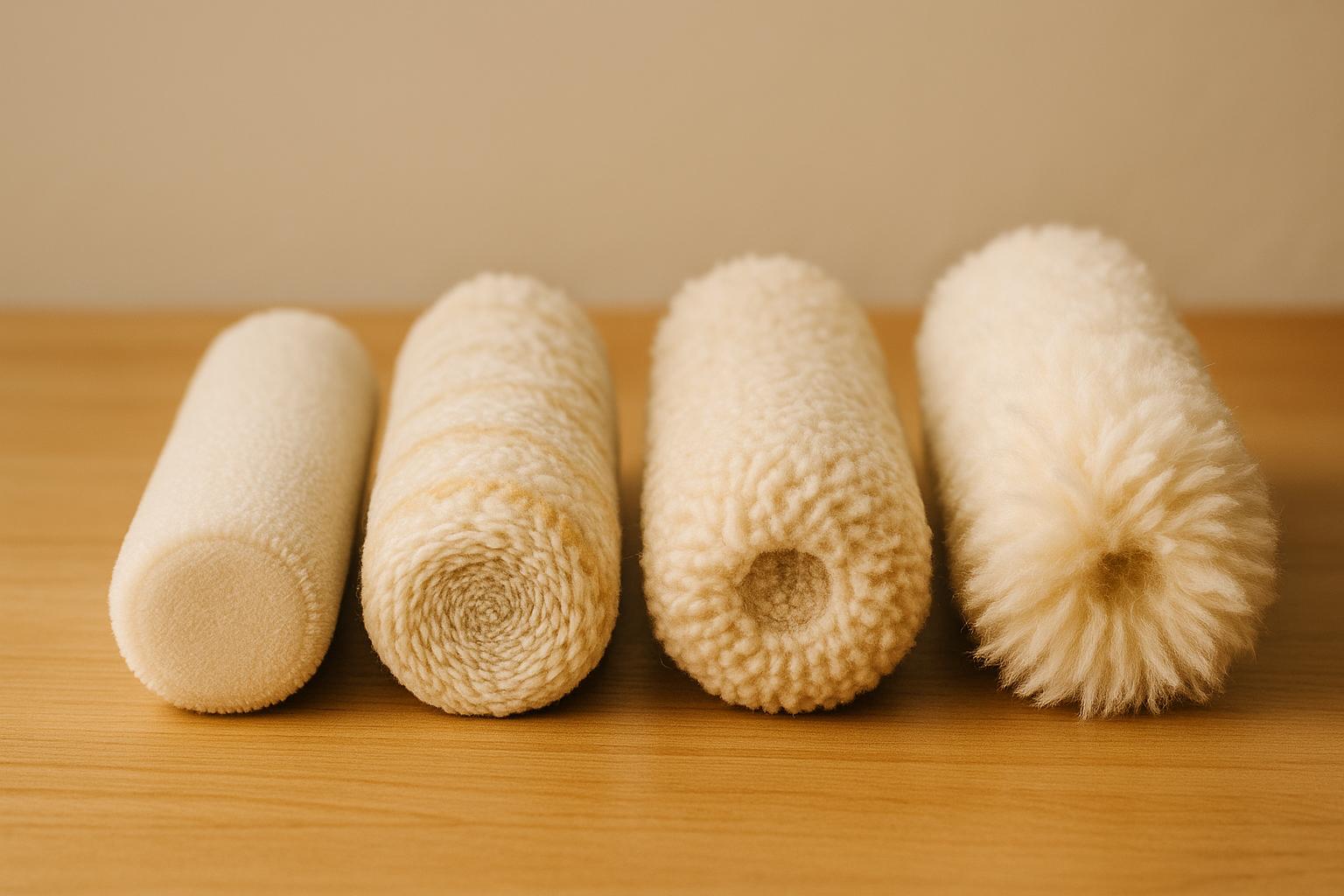
The roller nap you choose directly affects how paint is applied, how much it covers, and the finish quality. Here's the quick takeaway:
- Smooth surfaces (like cabinets or metal doors): Use 3/16" to 1/4" nap for a sleek, flawless finish.
- Standard walls and ceilings: A 3/8" to 1/2" nap works best, balancing coverage and smoothness.
- Rough surfaces (like stucco or brick): Opt for 3/4" to 1 1/2" nap to hold more paint and fill textures.
Different materials also matter. Foam rollers are ideal for smooth finishes, while microfiber and knit rollers handle textured surfaces better. Pairing the right nap size and material with your surface and paint type minimizes waste, reduces effort, and ensures consistent results.
Ready to dive deeper? Let’s break down nap thickness, paint compatibility, and practical tips for a professional finish.
Roller Covers // Everything YOU Need to Know
What is a Roller Nap and How Does It Affect Paint Application?
A roller nap is the fabric covering on a paint roller that picks up and applies paint [7]. Think of it as the "working" part of the roller - it takes paint from the tray and spreads it onto walls, ceilings, or other surfaces.
Understanding how roller naps function is key because they directly impact how much paint the roller holds, how smoothly it applies, and the final finish. Different naps are suited to specific textures and paint types, so selecting the right one can make all the difference [6]. Let’s dive into how nap thickness plays a role in paint application.
Nap Thickness and Its Role
Nap thickness is measured in fractions of an inch, with common sizes like 3/16", 1/4", 3/8", 1/2", 3/4", and 1 1/4" [1][7]. This measurement determines how much paint a roller can hold and how it releases that paint onto the surface.
- Thicker naps hold more paint, making them great for textured surfaces. They help fill in crevices and valleys, speeding up the painting process and providing better coverage [6].
- Thinner naps hold less paint, offering controlled application with minimal drips or waste. They’re ideal for smooth surfaces where precision is key [6].
Using the wrong thickness can lead to issues. For instance, a thin nap on a rough surface won’t carry enough paint to fill in texture, leaving patchy coverage. On the flip side, a thick nap on a smooth surface can waste paint and leave an unwanted texture [1].
Nap thickness also affects roller stipple, or the small dots or textured marks left behind after painting. Shorter naps create less stipple, resulting in a smoother finish, while thicker naps can leave more noticeable texture, especially on smooth surfaces [1]. A 1/2" nap strikes a good balance for semi-smooth surfaces, offering decent paint capacity with minimal stipple [1].
Here’s a quick guide to how different nap thicknesses perform on various surfaces:
- Short naps (3/16" to 1/4"): Perfect for smooth surfaces like new drywall, sanded wood, and smooth plaster. They’re ideal for glossy or semi-gloss paints [1][6].
- Medium naps (3/8" to 1/2"): The go-to choice for most interior walls, ceilings, and lightly textured surfaces. They work well with flat, satin, and low-sheen paints [1][4].
- Long naps (3/4" to 1"): Best for rough surfaces like stucco, textured walls, and concrete. They hold more paint, making it easier to fill deeper textures [1][6].
- Extra-long naps (1 1/4" to 1 1/2"): Designed for heavily textured surfaces like brick and concrete blocks. These naps hold a lot of paint and are effective for covering deep textures [1][7].
Common Nap Materials
The material of a roller nap is just as important as its thickness. Different materials influence how the nap interacts with the surface, its durability, and the final finish [7]. Here’s a breakdown of common nap materials:
- Foam naps: Great for smooth surfaces like new drywall. They provide precise control and a clean finish but don’t hold as much paint as fabric options [7].
- Woven or knit naps: Ideal for textured surfaces. Their fiber structure allows them to reach into uneven areas. Materials like polyester and lambswool hold more paint, making them suitable for larger projects where speed is important, though they may leave some stipple [4][7].
- Microfiber naps: Versatile and effective on both smooth and textured surfaces. They’re especially good for premium paints, delivering a polished finish on smooth surfaces [3][7].
- Specialty materials: Options like mohair, mock mohair, and sheepskin cater to specific needs. Mohair and mock mohair are excellent for smooth finishes on cabinets, doors, and trim, while sheepskin works well on rough surfaces due to its ability to hold large amounts of paint [6].
The combination of nap thickness and material determines how paint flows, how evenly it covers, and the finish you achieve. Choosing the right roller nap ensures your paint job is efficient and delivers the results you want.
Choosing the Right Nap Thickness for Different Paint Types
When it comes to painting, matching your roller's nap to the type of paint you're using is a game-changer. The thickness and texture of the nap directly impact how much paint the roller holds and how evenly it spreads. By selecting the right nap for your paint, you'll save time, reduce waste, and get a cleaner, more polished finish.
Flat and Low-Sheen Paints
For flat and low-sheen paints, a nap thickness of 3/8 inch to 1/2 inch is ideal[6]. If you're painting smooth interior walls, a 3/8-inch nap helps minimize stippling and creates an even finish. On the other hand, a 1/2-inch nap works better for drywall and ceilings, as it holds more paint and covers larger areas more efficiently. These medium-length naps strike a balance - offering enough paint capacity while maintaining a subtle texture that suits surfaces like drywall and plaster.
Glossy and Semi-Gloss Paints
Glossy and semi-gloss paints require a different approach. These paints are thinner and more fluid, so a 3/16-inch to 1/4-inch nap roller is your best bet[6]. The shorter nap holds just the right amount of paint to deliver a smooth, reflective finish without adding unwanted texture. These rollers are perfect for ultra-smooth surfaces such as new drywall, sanded wood, smooth plaster, or even metal.
Textured and Heavy-Bodied Paints
For textured or heavy-bodied paints, you'll need a thicker nap - 3/4 inch to 1.5 inches[6]. A 3/4-inch nap is great for moderately rough surfaces like textured drywall, rough plaster, or lightly textured exterior walls. For tougher jobs on extremely rough surfaces - think brick, concrete blocks, or heavily textured renders - a thicker nap (1.25 to 1.5 inches) ensures even coverage and fills all the nooks and crannies effectively. These longer naps are built to handle the demands of thicker paints, making sure every surface gets the coverage it needs.
Quick Reference Guide: Matching Nap Size to Paint Type and Surface
Choosing the right roller nap is essential for achieving a professional paint finish. This guide breaks down the details into actionable tips and a handy reference table to simplify your selection process.
Nap Size and Application Comparison Table
Here’s a quick comparison of nap sizes, their ideal uses, compatible paint types, and the surfaces they work best on. For most interior projects, a 3/8" to 1/2" nap is a reliable choice, perfect for walls and ceilings with flat, satin, or low-sheen paints[1][2].
| Nap Size | Best For | Paint Types | Surface Characteristics | Finish Quality |
|---|---|---|---|---|
| 3/16" to 1/4" | Ultra-smooth surfaces (drywall, metal, cabinets) | Glossy, semi-gloss | New drywall, smooth plaster, sanded wood, metal doors | Ultra-smooth, flawless |
| 3/8" to 1/2" | Standard interior walls and ceilings | Flat, satin, low-sheen | Smooth to lightly textured drywall, paneling | Even, minimal stipple |
| 1/2" | Lightly textured surfaces | Flat, satin, low-sheen | Lightly textured walls, decks, concrete | Smooth with better coverage |
| 3/4" to 1" | Rough surfaces | Flat paints | Textured walls, stucco, wood, textured ceilings | Textured, full coverage |
| 1 1/4" to 1 1/2" | Extremely rough surfaces | Flat paints | Brick, concrete blocks, heavily textured exteriors, masonry | Deep texture coverage |
Professional painters often keep a variety of nap sizes on hand. For example, a 12mm (approximately 1/2") nap is great for walls, while a 20mm (around 3/4") nap is ideal for textured ceilings[5].
Tips for Selecting the Right Nap
While the table above is your go-to reference, here are some practical tips to help refine your choice:
Assess the surface by sight and touch. Smooth surfaces like new drywall or metal are uniform and lack visible texture, making a 3/16" to 1/4" nap the best fit[1][2]. Slightly textured surfaces, such as lightly textured drywall, call for a 3/8" to 1/2" nap[1]. For rough surfaces with deep grooves, refer to the table for the appropriate nap size. Running your hand over the surface can also help you gauge its texture - smooth surfaces feel even, while rough ones have distinct irregularities you can feel[5].
Start with the paint type. Glossy and semi-gloss paints require shorter naps to maintain their reflective finish, while flat paints work well with medium naps[1]. Always match the nap to the paint sheen first, then consider the surface texture.
Choose between nap sizes based on your priorities. If you’re aiming for a smoother finish, go for the shorter nap, even if it means making a few extra passes[1]. For faster coverage, a longer nap will hold more paint, reducing trips to the tray[1].
Factor in temperature and humidity. Humid or cooler conditions may call for slightly longer naps to help maintain consistent paint flow. On the other hand, warm temperatures can speed up drying time, which might influence your choice[4].
Test before committing. If you’re unsure, paint a small section first to ensure the finish meets your expectations[1]. This simple step can save you from redoing large areas later.
For those juggling multiple painting tools and supplies, platforms like Toolstash can help you keep track of your roller inventory. Knowing what nap sizes you already have on hand - and where they’re stored - can save time and effort during your next project.
How to Use Roller Naps for Best Results
Picking the right roller nap is just the beginning - how you use and maintain it makes all the difference. Adjust your technique to match the nap for the best outcome.
Common Application Mistakes to Avoid
Using the wrong pressure or loading too much or too little paint onto the roller can ruin your results. For example, if you pick a nap that's too short for a textured surface, you'll end up with uneven coverage. On the other hand, using a nap that's too long on a smooth surface can leave a stippled, bumpy finish. This is especially noticeable with glossy or semi-gloss paints, where a nap longer than 1/4 inch exaggerates any flaws because of the paint's reflective quality.
For flat or low-sheen paints on standard interior walls, a nap shorter than 3/8 inch might not hold enough paint, forcing you to make extra passes and wasting materials. If you use a thick nap with thinner, glossy paint, you'll likely deal with messy drips.
To avoid these issues, roll the roller gently in the tray to evenly saturate it with paint, then apply smooth, overlapping strokes. Be careful not to overload the roller - roll off any excess paint in the tray. Keep a wet edge as you work to prevent lap marks. Consistent pressure, the correct nap size, and thorough mixing (or combining multiple cans of paint for large projects) are all key to avoiding uneven color and sheen. [1]
Environmental factors also play a big role in how your paint job turns out.
Temperature and Humidity Considerations
The weather and room conditions can seriously affect how paint behaves. High humidity (above 85%) slows drying, which can lead to sagging or runs - this is especially tricky when using thicker naps that hold more paint. Cold temperatures (below 50°F) make paint thicker, so even a thick nap might not release paint evenly. If you're painting in the cold, try warming up the paint slightly or using a thicker nap to compensate. In hot, dry conditions (above 85°F with low humidity), paint can dry too quickly, causing lap marks because strokes don’t blend well.
To adapt, use shorter, more controlled strokes in humid conditions and work on smaller sections in hot, dry environments to keep a wet edge. Surface prep matters, too. For smooth surfaces (where shorter naps are best), make sure the area is clean, dust-free, and well-sanded - any debris will show. On textured surfaces, imperfections are less noticeable, but cleanliness is still important. Also, priming new drywall or porous surfaces ensures even absorption and better coverage. [2]
Once you've finished painting, proper cleaning keeps your rollers in good shape for future use.
Cleaning and Maintaining Your Rollers
Cleaning your rollers right after use can extend their lifespan. For water-based latex paints, rinse the roller under running water, working the paint out of the fibers by hand or with a roller spinner until the water runs clear. For oil-based paints, use a solvent like mineral spirits or paint thinner in a well-ventilated area, and always follow local disposal guidelines.
If you’re planning to continue painting within 24 to 48 hours, wrap the roller tightly in plastic and refrigerate it to keep the paint from drying out. For long-term storage, make sure the roller is completely dry before sealing it in a container to prevent dust buildup. Lambskin and microfiber rollers need gentler care and should be stored separately to avoid contamination.
High-quality rollers, like 12 mm nap rollers, can provide smooth, even coverage without excessive splatter when properly maintained. Many professional painters keep a variety of nap sizes on hand - such as 20 mm rollers for ceilings and 12 mm rollers for walls - to handle different surfaces. With good care, a roller can work just as well on its tenth use as it did on the first.
If you’re juggling multiple projects or managing a collection of rollers, staying organized is essential. Tools like Toolstash can help you keep track of your rollers and their condition, so you’re always ready for your next job. [5]
Conclusion
Picking the right roller nap might seem like a small detail, but it can make a world of difference in how your paint job turns out. For smooth surfaces and glossy or semi-gloss paints, shorter naps (3/16" to 1/4") are your go-to for that sleek, polished finish. Medium naps (3/8" to 1/2") are perfect for most interior walls with flat or low-sheen finishes, offering a reliable option for everyday projects. When it comes to rougher textures like stucco or brick, longer naps (3/4" to 1 1/2") are a must - they hold more paint and can get into those tricky grooves with ease.
Choosing the right nap size upfront isn’t just about the finish - it saves you from wasting paint, spending extra time on additional coats, and dealing with unnecessary frustration.
As highlighted in the quick reference guide, it’s helpful to match the roller material to the surface. Foam rollers are excellent for ultra-smooth finishes, woven rollers work well on textured surfaces, and microfiber rollers provide a versatile option for a range of finishes. Many pros keep a variety of rollers on hand, like a 3/4" nap for ceilings and a 1/2" nap for walls, to handle different tasks efficiently.
With proper cleaning and care, a good-quality roller can last through multiple projects, consistently delivering professional results. And if you need extra help staying organized or managing your tools, tools like Toolstash can make your DIY projects a breeze.
Now you’re equipped to pick the perfect roller nap for any painting job. Make the right choice, work smarter, and enjoy a flawless finish.
FAQs
How do I choose the right roller nap for my paint and surface?
Choosing the right roller nap is all about matching it to the paint you're using and the surface you're working on. Here’s a quick guide:
- Short naps (¼" to ⅜") are perfect for smooth surfaces like drywall or wood, providing a clean, even finish.
- Medium naps (½" to ¾") are great for semi-smooth surfaces, such as lightly textured walls or ceilings.
- Long naps (1" or more) are designed for rough surfaces like stucco, brick, or concrete, allowing the roller to reach into grooves and uneven spots.
The roller material is just as important. Synthetic fibers pair well with latex paints, while natural fibers like lambswool are better for oil-based paints. By choosing the right nap length and material, you’ll make the job easier and get results that look polished and professional.
What happens if I use the wrong roller nap length for a specific surface texture?
Using the wrong roller nap length can mess up your paint job, leaving you with uneven coverage and a less-than-ideal finish. For instance, if you use a roller with a short nap on a rough or textured surface, it won’t hold enough paint, which can result in gaps or an inconsistent look. On the flip side, a long nap roller on a smooth surface might apply too much paint, leading to drips, streaks, or a coat that’s way too thick.
The key to a great result? Choose the right roller nap for the surface you’re working on. Rollers with shorter naps (like ¼" or ⅜") are perfect for smooth surfaces such as drywall. But for rough surfaces like stucco or brick, go for a longer nap (¾" or more) to ensure even coverage.
How does the roller nap material impact the quality of my paint finish?
The type of material used in a roller nap significantly impacts how your paint job turns out. Synthetic fibers, such as polyester or nylon, are a great match for water-based paints because they maintain their shape and resist flattening during use. Meanwhile, natural fibers, like lambswool, are better suited for oil-based paints, offering smooth and consistent coverage.
Selecting the appropriate nap material not only improves paint application but also minimizes streaks, helping you achieve a polished, professional finish. Pairing the material with the correct paint type is key to getting the best results.